Visualizzazione post con etichetta Paris 2024. Mostra tutti i post

domenica 4 agosto 2024

Paris Olympics: athletics (02-08-2024)

 Clicca qui per la versione italiana

I arrive at the metro stop (which is not the one recommended by the guide, but it allowed me to get there from the hotel without changing) half an hour before the start and I ask myself 'will that be enough? Were it World or European Championships, I wouldn't worry so much about missing a heator two of the 100 in the decathlon, but my first athletics session at the Olympics I want to see it all. At the end of the avenue there is a first check of the rucksacks by the police, with a personal search: they even touch the button on my shorts. I arrive in front of the Stade de France and, unlike all the other competitions so far, my entrance is not the first one I encounter, in fact I have to make almost half a lap around the stadium. I find a gate with a long queue, and I hope that mine is not the same, instead there is more or less the same queue, but it's done quickly. We pass the ticket at the turnstile, it is the first event where there is no manual check.


Eventually I arrive inside the stadium 2-3 minutes before the start; they are presenting Bob Beamon and immediately afterwards they start with the decathlon presentation. My seat is in the first row of the second deck (out of three), far from the aisle: I think it will be a problem to get up during the session, but luckily it is not very hot and so drinking is not essential, so I manage not to take any breaks. My block is full, but in other blocks there are a few empties: such a full house for a morning session, however, I had never seen it, not even in London (where it was close). I'm at the start of the 200 metres, I have the balustrade in front of me, so I have to move slightly to see the outer lanes and the long jump sand, but I'm in an excellent position for LJ and  SP of the decathlon: in particular for one platform of LJ  I have the sandbox right in front of me and I can perfectly see the take-off and landing.


The row behind me is mostly occupied by Germans, a few rows behind there are Italians, you can also see a lot of Americans, but as soon as they announce the first French athlete, the decathlete Gletty, you can see that the home support is clearly predominant. Every time a home athlete takes to the track or the field the stadium explodes, even in the high jump qualification they celebrate every successful jump of their athletes almost like a medal. I have to say that in 2003 I did not remember such passionate cheering, but it may also be that back then they had more top athletes and so it seemed normal that they got excited for them.

 embrava normale si esaltassero per loro.


So we start with the decathlon's 100. After the first heat, they announce the first group of the hammer qualification. The scoreboard does not show the results; I think of a malfunction, but then, when it activates, I discover that they had not actually started yet, they were warm-up throws. Then there ts the women's high jump qualification (no Italians, how sad), which take place on the opposite side to mine, but with my old binoculars, bought right here at the 2003 World Championships, I can still follow them. They start at 1.83 and already two are out, including Levchenko, increasingly a shadow of the champion she once was. At 1.88, 5 athletes are out and Cunningham and Topic save themselves at the third, as well as at 1.92, where 14 remain and Demireva and Lake, among others, get out. They go to 1.95 (the qualification would have been 1.97), which only 6 clear: only Onnen is left out, who in addition to 1.88 and 1.92 in the third round had also cleared 1.83 on second.

 Then there is the preliminary round of the 100, which by definition only includes athletes who are the only ones from their countries: of some I am surprised that they do not have qualified athletes, especially Grenada, which has many top male athletes. Then we come to the first race with Italians: the 1500. First Meslek and then Riva collapse in the final and arrive far behind, but perhaps, as they would not have passed, they reserved themselves for the repechege round. In between, however, there was Arese, who always stayed with the leaders and in a big sprint even gave the impression of winning, but actually came third. In these first races you also have to get used to the new jerseys, which make some countries difficult to recognise. The most unrecognisable are the British, in black, then the Germans have an ochre that is more reminiscent of Australia, the Italians a faded blue, the Americans are a bit in grey a bit in blue, the Norwegians a bit in white and a bit in blue, the decathletes will also change throughout the competition. 


It comes down to the first 'real' round of the 100. I am completely on the opposite side, so I struggle to distinguish the placings at the finish, especially of the athletes in the outer lanes. In the first heat Sha'Carri immediately shoots 10.95 braking in the final, in the second Dosso starts well, then holds third place, but with 11.30: at the end 7 athletes will be eliminated with better times (but hers was also the heat with the worst wind). In 6 heats there will be at least one athlete under 11", in one even two (Ta Lou and Fraser-Pryce).

 Meanwhile, the decathlon continued first with the long jup, then the shot put. In both cases, the platform of the best was the one closest to me, In the long, Skotheim gets to 8.03, Neugebauer to 7.98, and I could see their borderline take-offs well, in the shot put, the French were exalted by Gletty, who took the best measure ahead of Neugebauer, who ended the morning in the lead.


Once the session is over, I decide to go home to rest, and seeing the queue to enter the metro, I wonder if I have made the right choice, When I return for the evening session, I have even less margin than in the morning: I seriously risk seeing at least the decathlon's high jump begun. In front of the gates, a volunteer points out to us that it is not compulsory to enter through the entrance shown on the ticket: I therefore decide to enter at the first gate I find and then move inside the stadium, as this saves distance. The bag check is the most thorough one I have ever undergone here: they make me open three pockets, usually they are satisfied with one or two (there are four in total, probably the fourth onehe I had not noticed). I look out into the stadium that the races have yet to start, but this time I really have to get a drink, so I miss a few decathlon jumps.

 I am in the first bend, slightly higher than this morning. So I see the high jump of the decathlon very well, but more or less badly everything else, the shot put is on the other side, I see the triple jump from behind and so I can't get an idea of the measures, even for the track races I don't have a good perspective for the finish placements. What's more, I only see one scoreboard. Next to me there are French, on both sides, but nearby I see Germans, Spaniards, a few Australians and an Irishwoman. In front you can see a sector of Irish and when they announce the relay you can see that there are so many of them, all over the stadium. At that time the British will also show up. You always meet a lot of Americans and Puerto Ricans too.


The first trackrace are the 5000 metres: Battocletti does very well in the first heat0, where she led the race and came in just behind Kipyegon and Hassan, while in the second heat Del Buono holds on until three laps from the end, but then gives up. Then the qualification of the women's triple: as I said, I can't see much, the only way I can get an idea of the size is to see how close to the sand they get with the step. With this criterion, Derkach's first jump looks good to me and in fact first the images, then the measurement confirm it: 14.19. Since this measure should guarantee her qualification, I almost completely disregard the competition: I later read that she also did 14.35. Only at the end does the announcer draw attention to Orji, who risks elimination, but then qualifies, In all competitions, the scoreboard always gives the measurement needed to qualify, even at the beginning, when it is insignificant.

On the other hand, I see the discus platform well: I see Osakue in warm-up making a throw around the qualifying mark (64 metres), but I think she had also done this at the European Championships, but this time she will confirm herself in the race, with 63.11 on her second throw. You only realise that the race has started when Altman goes way over the qualification mark (69.59) and a similar thing will happen in the second group.

It comes down to the mixed relay and it starts immediately with the Americans' world record in the first heat. Great enthusiasm from the French, who finish second. In the second heat the British are enthusiastic and win, while the Irish, despite the cheering, are never contending. Italy gains qualification in the final, overcoming Nigeria.
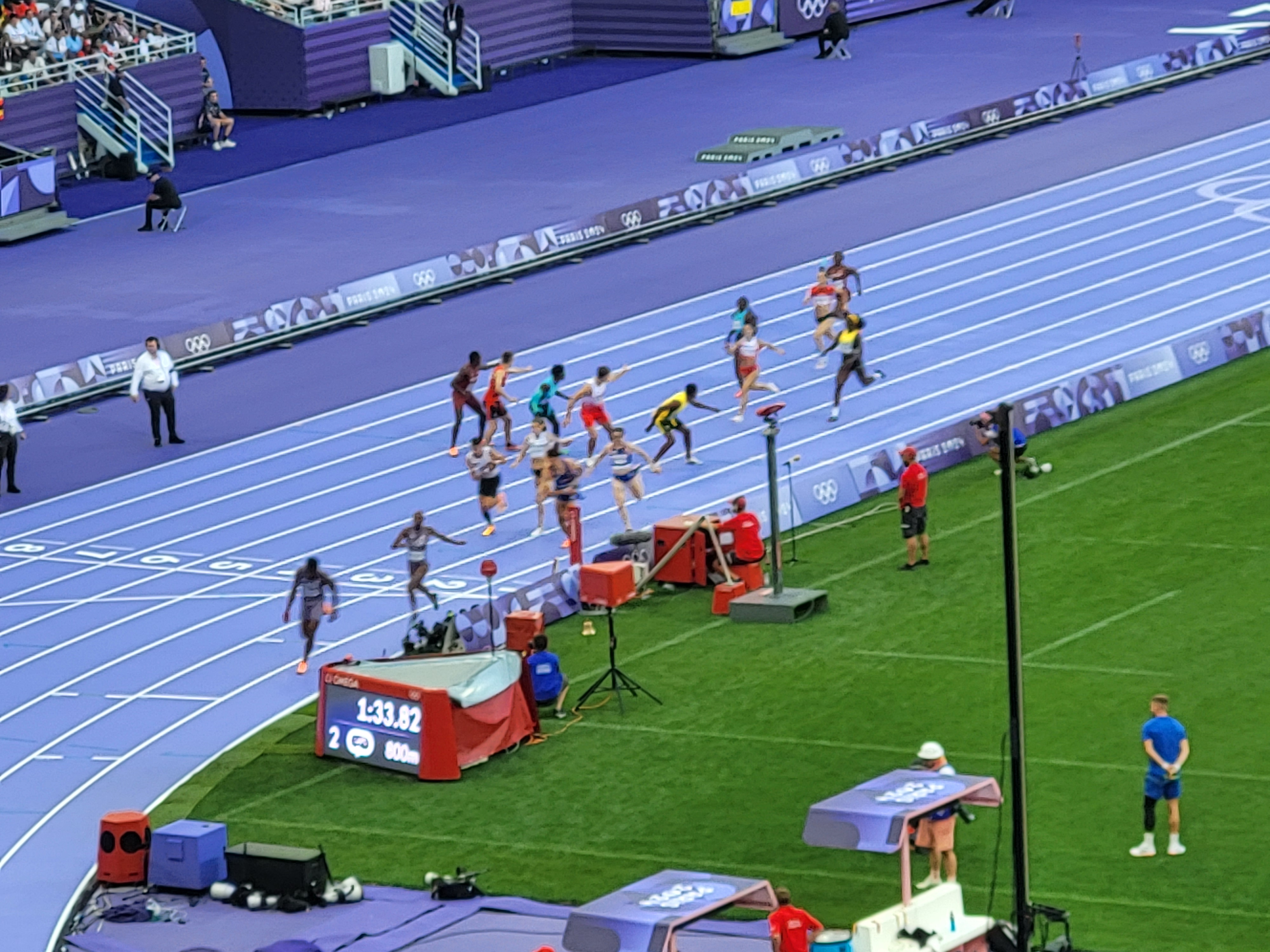

Having finished the mixed relay I thought I would go for something, but I stay to watch the epilogue of the decathlon high, which ends just before the 800 heats. I decide to walk away anyway, since the first Italian is in the third, but I come right back because there is too much queuing at the kiosks. I therefore manage to see the first heat as well. Of the Italians, Coiro comes close to qualifying and makes her personal best, Bellò stays further back. I didn't quite understand what the speaker turns "Coiro" into in English, it seems to me "Coairo", again with its horrendous pronunciations: "Iurena", Gàrcia", "Coul" (that would be Kaul).

 The highlight of the evening for us begins: the men's shot put qualification. From my position I can only see if a throw is before or after the two tapes (20m and the qualifier at 21.35), but if it is between the two I have no idea if it is closer to one or the other. Fabbri's first throw is worse than I had thought: 20.44 and in fact he would already be eliminated at the end of the first round. The second one looks very good, but it is nil. I think that even in Budapest he had only qualified on the third attempt and in fact he not only qualifies but makes the best measure.

Then there would be the 400 decathlon, but before the start of the first series there is a chorus that I don't understand at first, which doesn't stop, so much so that they have to postpone the start. Obtaining silence for the starter is often difficult, as I had seen in swimming, already once a 'Allez les bleus' had started with the athletes already on the blocks. When I see my neighbour watching the swimming on his mobile phone, I understand: it is "Allez Leon", dedicated to the swimmer Marchand, who is winning his fourth gold medal. Luckily it was 200 medley, not 1500, so after two minutes we can resume.

 At the end of the three heats of 400 field events have already been over for a while, so there is a break before the 10,000. I try again to get food: this time there is no queue, but there is nothing I like left. They start the 10,000, the only final of the day: the French incessantly support their Gressier and Schrub, who remain among the front runners at the start (towards the middle of the race Schrub will burst and retire). I realise that Kenya has to be added to the unrecognisable teams: only by comparing what I see with the placings on the scoreboard do I realise that it is them, they have a jersey similar to those of the Diamond League, which has nothing to do with their tradition. We get off to a fast start, thanks to the Ethiopians: first kilometre in 2'43", I had never seen a 10,000 at this level without an initial tactical phase. It goes on at 2'42 or less per kilometre until the 7th, only at the 8th did the pace slow down a little and the leading group regrouped, even Gressier came back. With 3 laps to go they accelerated again, at 300 metres Cheptegei took off and held the lead until the end, resisting the return of Aregawi and Fisher, silver and bronze respectively. The French celebrate Gressier's 13th place (anyway swith a national record, under below 27') as if it were a medal.


I see the celebrations of the medallists and Ethiopians and go, while many are still lingering. I walk out of the stadium as 'I will survive' rings out, only to realise shortly afterwards that I am going towards the wrong metro and where to turn back, making my way through all those going the other way

 My Olympic experience ends here, which causes a great sense of emptiness, but I think that there is one week left of the Olympics and that watching them on TV at least has the advantage that you can follow more competitions.


venerdì 2 agosto 2024

Paris Olympics: golf (01-08-2024)

 Clicca qui per la versione italiana

I arrive at the RER stop near the hotel, which should take me directly to the shuttle departure station, but I discover that the first train arriving there is in half an hour. Fortunately, I hear some French people say that you can also take the first train, in a few, minutes, and then change: after checking, I do so. The train also goes to the Château de Versailles: I also meet a group going to see the horse riding. At the departure of the shuttles there are still a lot of people, even though the game has already started a while ago: the start was at 9am, but I had never thought of being there at that time, my goal was to arrive for the departure of the first Italian, Migliozzi, at 10.22am. To get there you have to do a long serpentine: a volunteer, seeing me with my kneepads on, offers me to skip it: I refuse, but on the way back they insist and I accept. In reality the serpentine made no sense to anyone, there was no crowd to justify it (least of all on the way back).

 The shuttle leaves soon, the journey takes about twenty minutes. On arrival, there is an initial check of backpacks by the police (less thorough than yesterday, however), but then there is quite a stretch to get to the entrance, with ticket and backpack checks again. Once inside, there is still quite a bit of walking to do before we see the course. I see that by now my goal of seeing Migliozzi's start is missed, seeing that there are signs of a shortcut towards hole 4 I consider chasing him, but then I decide to follow Manassero, who starts at 10.55: I should have just enough time to go to the bathroom and get a drink, but then I postpone the latter because of the queues and considering that there should be other kiosks at hole 2. I see a lot of people getting burgers at 10.45.


I find out that the first spot on the course we see is not the start, but the green at hole 1. I therefore decide to wait for Manassero's group, the one before, consisting of a Thai, a Chinese and a Mexican, has just arrived. An Italian lady, with a strong Tuscan accent, seeing from my painted cheeks that I am a compatriot, asks me when the Italians are arriving. I notice that some golfers are wearing the national colours, others only a small badge, so when I see a player wearing a blue polo shirt I think he is the Italian, instead it is the Colombian Villegas: Manassero is wearing a darker blue shirt and trousers of the same colour.

 Having completed the first hole, I set off to follow the group, which in addition to Manassero and Villegas includes the Chinese Yuan. With me are a few Italians, but also a few Chinese and Colombians (of course, along with many others from other nations). In general, after the French the nationality most present is definitely the American, but I also meet many Finns (who have a player two groups after ours) and Danes. Then you always see Britons, Irish and Germans, and even a few Australians and South Africans. When I read that Migliozzi is already at -2 for a moment I think about going to follow him, but then I'm afraid that I have a long way to go in a short time: I will definitely abandon the idea when I see that he is already down to -1.

 At 4 o'clock I find out from the scorekeeper (the one following with the sign) that Manassero is at -1. I hadn't realised that he had made a birdie: I later discovered that I hadn't actually realised that hole 3 was a par 5 and not 4 (it seemed strange to me that there were no par 5s until 9th). At the 6th I start to feel the fatigue and I think about how I will get to the end, if I get there at all. In the meantime, however, it's a downhill hole that can be followed all the way from a hill: I can see it sitting down (on the ground, of course: there is only one grandstand, at the finish of the 18th, and it requires another ticket). At the 7th Manassero makes a birdie with a long putt, after missing a few by a small margin, and went to -2.


After the first shot of the 9th (par 5) I see that to follow it one has to take a winding road, while moving to the other side one can follow from 10th to 12th, at least the start, moving little. Since my energy is low, I decide to wait for the players on the green of the 10th. I see the rest of the 9th and I don't notice Manassero making a bogey, on the other hand I see his splendid second shot on the 10th, which puts him in position for an easy birdie. The 11th, on the other hand, without moving is not as clear as I thought: I don't notice that Manassero has made a double bogey, I can only see it from the score on the next hole (from a distance, it is not easy to distinguish when a player hits the ball from when he is only rehearsing, or inspecting the green).

 After the first shot on the 12th, I get going again, but the tiredness and heat are becoming more and more noticeable. I should also drink and go to the bathroom, but in order to do so I would have to detour, and it's already so much that I manage to make it the rest of the way, let alone any other way. I arrive at the 14th, where Manassero makes a beautiful approach shot from behind the bunkers and closes with a birdie, returning under par. At this point, I find myself where I was at the beginning and where there are kiosks and bathrooms: I therefore decide to stop. After the stop, I give up chasing the players on the 15th, which I don't even really understand where it is, and stop on the green of the 17th, where Migliozzi's group has just arrived. I read that Manassero had made the birdie and was again at -2, while Migliozzi was at -3 and the first, Matsuyama, at -8.


After Manassero's group had passed the green on the 17th, I wanted to follow them onto the 18th, but I was having trouble finding the tee: when I did find it, however, they hadn't left yet because they were waiting for the previous group. Arriving at the green on the 18th, the scoreboard gives instructions in case of bad weather, yet there are barely any clouds and a bit of wind. I see Manassero close with a par, at -2. Originally the idea was to sit in the grandstand to watch a few more finishes before going, but as I said, I discover that he requires a different ticket: at the Ryder Cup it wasn't like that, but anyway I suspected it as I had seen that there were more people sitting on the grass in front than in the grandstand

So I decide to end here: I eat, buy some merchandise (there's a very big shop) and look for the exit, only to discover that I have to go back to the green on the 17th: if I'd known, I don't know if I'd have gone to the 18th, but anyway it was worth it because of the shop. In passing, I find out that play has been suspended due to lightning risk: it seems a little strange considering that it is raining very little and at the same time there is still hot sunshine, but especially thinking of the conditions in which the last British Open was played. I then hear that it will soon start again, and in fact during the course they make us stop to let players pass; my neighbours (not me) recognise Fitzpatrick and Schauffele. Later on I meet Morikawa and at least I recognise him, it's easier.


Not many people come out, there's no queue at the shuttle, in fact you have to wait for it to fill up. At least there is a seat anyway. And tomorrow the grand finale with athletics,

giovedì 1 agosto 2024

Paris Olympics: table tennis and volleyball (31-07-2024)

 Clicca qui per la versione italiana

Today there was a day planned to be close to home: morning table tennis and afternoon volleyball, both at the Paris Sud Arena (different arenas), according to the guide at one metro stop. In reality I discover that it was not so on the doorstep: arriving at the indicated stop one had to walk almost 2 km, it was closer to walk directly from the hotel. So I arrive at the entrance that it is already 10 o'clock, the start time. The bag checks are also the most thorough, and consequently long, that I have encountered so far: they even examine my umbrella. What's more, my arena is the furthest away in the venue (or rather, its entrance, I will discover on the way out that the other side was much closer): there would also be a treadmill, but it doesn't work, and my sector is the furthest from the entrance. Passing by, Chinese fans are handing out cards cheering for Fan Zhenyong, No. 2 on the scoreboard, who is playing at 12 o'clock. I get into the grandstand and struggle to find my seat and need assistance, as the numbers are on the inside of the seats and when they are occupied they cannot be seen.

 ccupati non si vedono.


As soon as I take a look at the coiurts, I realise that it will not be easy for a neophyte like me to understand them. I had already seen the final of the 2022 European Championships, but as a final, it was a single match, this time there are four of them side by side: you often hear shouts and the problem is to understand which match they are associated with. Even the scores, of course, are not told: there are scoreboards next to each court (but the far one doesn't always read well) and there is a summary one next to my sector, but the courts are not in the order we see them (I later find out that they are in order of court number, and courts 1 and 2 are the middle ones).


I am all on one side of the arena, so I can see a match very well, but for the one further away you need binoculars. From closest to farthest for me, the matches are between a Korean and a Hungarian, a Japanese and a Hong Konger, a Chinese and a Swede and a Briton and a Slovenian. At first I think I only look at the one closest to me, but you can't, the shouting from the other courts distracts you too much. Soon I realise that most of the shouting refers to the match between Chinese Wang (who I later find out is the No.1 seed) and Swedish Moregard, who is surprisingly ahead. The Chinese has the support of the many countrymen present, the Swede that of the rest of the audience, not just the Swedes, who are also quite numerous. After all, I too understand that it's the match at a higher level. The British cheer for their player also makes itself felt. The other three matches end almost all at once, although they were one in 4 sets, one in 5 and one in 6: we can concentrate on Wang-Moregard, then won by the Swede in 6 sets. The winner takes a knee and the whole audience applauds him.


Out go the last two players of the first turn, in come those of the second turn. Hardly anyone leaves their seats, so I don't either. Here the most popular match is between the Iranian Alamiyan and the Japanese Morimoto: both have a lot of fans in my block, probably the Iranian more, but those of the Japanese (including my neighbour, who is not Japanese) are very vocal. The Iranian is funny: he has unorthodox strokes and makes great recoveries, but he also makes a lot of mistakes and finds himself down 3-1. In the fifth set he recovers, but ends up losing 4-2. I also try to have a look at the women's seed no. 1, China's Sun, who dominates a Luxembourger also of Chinese origin: 4-0. with only the third set hard-fought. Especially in the breaks of the others, I also take a look at the match furthest away from me, that between the Indian Akula and Zeng from Singapore: the Indian, favourite, finds herself down 2-1, but then wins 4-2. Like many I think, I will instead follow very little the match closest to me, that between Dane Lind and Pole Redzinski, which also, from what we can glimpse, has some very spectacular moments. It will only get attention when, by now in the 7th set, will be the only match remaining; the Dane will win.

Third round of matches, where there is the highlight for most spectators: the Frenchwoman Yuan against a Canadian also of Asian origin. Only now do I realise how the French are still clearly in the majority, despite the strong international presence, especially Chinese. They will support their player not only with the usual 'Allez les bleus' chorus, but also with 'whoever doesn't jump is not French' and during the fourth set, with the game in progress, they will start singing the Marseillaise (after all, this is not tennis...). I too mainly follow the Frenchwoman's match, both because it is the one closest to me and because it is the one that elicits the most reactions from the public, but it is certainly not the most spectacular: monotonous play, diagonals close to the table until someone makes a mistake. There is also Fan, playing against a Hong Kong player, who dominates two sets, loses one and then dominates again: 4-1. I also try to follow the match further away from me, where the Egyptian Meshref resists the no. 3 seed, the Japanese Hayata: it ends 4-0, but three sets are very hard fought, the first one ending 15-13. The most interesting match is the one between the American Jha and the Greek Goumis: the Greek has very peculiar strokes, which look more like tennis than table tennis. He loses the first three sets, however, but then wins two and so their match remains the last. A few Frenchmen left after their player left, but most stayed. It ends 4-2 for the American.


I go back and forth from the hotel, and around 5 p.m. I am back in the area. Incidentally, Arena 1, where the Serbia-United States volleyball match is taking place, is even a little further away than this morning. Had I known beforehand that there was all this way to go, I would have considered staying in the area, but I would have had to bring my PC and then I don't know where I could have settled in. I decided to leave my backpack at the hotel, so at least I'll go in straight away, without any checks. Entering the arena, I feel a chill, as I did this morning, but fortunately in the stands the temperature is more normal. It takes me a moment to find my seat, but for once it is an aisle seat.

 When I get to my seat, the score is 6-4 for the USA. The announcers are explaining the choreography for a great block (‘monster block’), then they explain the choreography for an ace and a grat spike (‘super spike’). The leitmotif of the match will be just that: a lot of choreographies and various entertainments, so much so that the match itself will be lost sight of. The competitive tension will almost only be felt in the fifth set. We will also be asked to move our arms left and right, alone or with the torches of our mobile phones (and almost everyone will obey, including me) and between the third and fourth set there will also be karaoke.


There are many Americans, certainly more than Serbs, but many nationalities are represented, perhaps the most international audience I've seen here (but maybe that's just an impression because the French, not being involved, didn't make themselves heard). At some point they ask us to show the flags, and we see flags from many countries: after the American and the French, perhaps the most present is that of Mexico, certainly more than the Serbian.


In the first set, after a balanced first part, the Americans took a 22-14 lead, partly on their own merit, but much thanks to errors by the opponents, then they closed 25-17. It was a similar story in the second set: Serbia made a few good moves and took the lead, but then began to make mistakes and the Americans took the lead, winning 25-20. In the first two intervals between sets a dancer-contortionist performs. In the third set the level goes way up: out of 45 points, only eight will be due to errors. There are many long and spectacular rallies, Serbia shows what it can do and wins 25.20. When Serbia takes the lead, for the first time the cheering of the Americans can be heard. In the fourth set Serbia's dominance was even clearer, the Americans seemed to not know what to do to stop them: it ended 25-14.

So we arrive at the fifth set which, as I said, is the only one where you can hear the cheering at every point, especially that for the USA, but also that for Serbia, not only of the Serbs: my neighbour supports Serbia, but she speaks English. Even the speaker will ask to cheer for one or the other. In the first half of the set Serbia is almost always ahead, up to 8-5, then the USA come back, overtake on 9-8 and take the lead, with Serbia seemingly unable to defend. They reached 14-11: the crowd was on its feet for the three match points, but Serbia cancelled the first two, and the third was wasted by the Americans with a mess in defence. At the fifth match point, on 16-15, twice the Serbs recovered when it seemed done for the Americans, but in the end they sent out a spike, thus ending 17-15.


On the way out we cross paths with the audience of the following sessions in the different arenas, after dinner I meet a procession of Polish fans. who are going to the next volleyball match, Poland-Kenya.

 Tomorrow another day of walking: golf awaits me.

mercoledì 31 luglio 2024

Paris Olympics: rowing and swimming (30-07-2024)

 Clicca qui per la versione italiana

And the day finally came, for the first time in my life I saw an Italian win a medal at the Olympics. 12 years ago, in London, I had seen the medal being prepared and the certainty of winning at least silver, but I had not seen the final. Thank you, Greg Paltrinieri, even though for a moment we hoped it would be even better, it is another medal that enriches a fantastic career.


But let's start from the beginning. The day had started early (way too early) with the rowing session. I arrive at the shuttle station around 9.15, by which time it was clear that I would see it begun (start was at 9.30). There are, however, a few people arriving at this time. Among them are the relatives of Nicolas Kohl, of the Italian four, whom I meet on the shuttle: in all my stay in Paris so far, I had never seen so many Italians together. When the shuttle arrives, there's still a long way to go (I'll measure it on the way back: it's about 1250 metres): when I had been to see whitewater canoeing, I had seen that the flat water basin was further away, but I didn't think it was that far.


I go in at almost 10 o'clock and it is already very hot, I look at where my seat is and discover... that I don't have a seat: they are standing places! I go back to wondering why I was doing that, after I had already done it when I got up. The fourth quarter-final of the women's sculls is under way: I settle in the first place I find, towards the 1500 m buoy, waiting for them to pass. Finished, I make to move away, but I see that the first quarter-final of the men's sculls is already about to start. The races are practically ontinuous: the starts are every 10 minutes, which means that between the arrival of one and the start of the next there are about 3 minutes, but they are not noticeable: having proclaimed the official result of one race, they begin the presentation of the next.


I go a few metres further towards the start, and from there I see the first two quarters of the sculls, I notice that the period when the boats are in sight is about 2 minutes. Then I really have to go for a drink and to the toilet. On the way back, I look for better accommodation: I find a less crowded place, where I can also sit when the boats are far away. However, it has the disadvantage of being far from the screens, so most of the time you have to rely on the speaker to find out the placings. From this position the boats are visible from just before the halfway point until almost the finish, but the stretch where the perspective allows you to understand the placings is much shorter, no more than 250-300 metres. Around me only French, further on a Dutch family: after the locals, the nationalities most present are Dutch and Danish.


We arrive at the first competition for both us and the French: the first semi-final of the women's doubles. The French are thrilled with their crew, which is always in a qualifying position (top three) and at times seems to be able to attack for first place. They celebrate qualification with ‘who doesn't jump is not French’ (it will be heard again tonight at swimming). Italy remains last all the time and even loses contact with the penultimate in the final. After the semifinals of the men's doubles, with France failing to qualify and Italy absent, the French around me leave and so I can advance almost to the first row. I see the recoveries of the four, first women's (without Italy) and then men's, where we take revenge on France: Italy is in the lead the whole time, after it has passed me it seems that Romania and France are catching up with it, but it's perspective, in reality we are firmly in the lead and we win over Romania and France, which therefore remains out (two were passing).


Once the races are over, it's back to the start of the shuttle,s in a devastating heat. The queue for the shuttles is long, but it is over in a quarter of an hour: I confirm that it is the most efficient shuttle service I have ever seen.

In the early afternoon I visit the Parc des Nations, the village that hosts the ‘houses’ of different countries. I visited those of Colombia and Mexico, among the few with free entry, i.e., requiring neither payment nor registration. A good experience, a pity I didn't have more time.


And we come to the evening session, with swimming. I arrive at La Defense with a good margin, almost an hour, but 10 minutes pass to get from the metro station to the arena and just as many in the queue at the gates. I am however inside the arena just before 8pm, so I decide to get some food. It doesn't turn out to be a good idea: we don't understand each other and instead of the curry toast I had ordered I get two beers. When I manage to get the toast, I discover that I don't like it and throw it away.


Eventually the margin is almost over, I arrive at my front door with 10 minutes to go. I open the door and find myself in front of the pool, very close, only a few steps down. I can't actually see much because they are playing a light game, but when the lights come on I can see better how close it is, and I remain so even as I climb up to my seat. The seats next to me are already occupied, but in the row there are a few vacant ones left, then they will fill up, but in other blocks there will be a few empties, although I think the block with the most empties was the athletes' sector. Next to me, on one side are French, on the other some Asians, who when they announce their athlete (in the 200 butterfly) I discover are from Taiwan. In my row there are also Chinese from the People's Republic and even Colombians (Colombia was not represented). In the front row, Americans and British, around, Australians and, it will be seen in the 800 sl, also many Irish. In the front rows there were also many Italians.

Already when they announce the participants in the first race, you can see that, after the French, the most numerous are Americans and British, but there are also numerous Australians and, as I said, Irish, When they announce Noè Ponti you can see that there is also a good representation of Swiss. The Chinese are also more than yesterday in archery (I went to see the team archery yesterday, but due to technical problems with my PC I couldn't write about it). Among the countries with a swimming tradition, Hungary, Canada and Sweden are underrepresented. The former I think is even the only country represented, apart from Kyrgyzstan, whose flag I did not see: I also saw one from the Philippines and a small group from Iceland. But the strongest cheer is always for home athletes: the French are especially excited about Marchand, the 400 metres mixed champion, who competes first in the 200 butterfly, winning the semi-final and reaching the final with the second fastest time, and then also in the 200 breaststroke (and the first time I have ever seen one compete in the breaststroke and another style), where he will set the best time. In the breaststroke they will also mark the rhythm of his every stroke. Sometimes the enthusiasm (not only of the French) is such that it is hard to get silence for the start.


I soon realise that my position, behind the pool on the start side, is excellent for watching the swimmers' arrival, their preparation and the start (I will later discover that it allows me to see them very closely, after the race, because they have to pass by the table right in front of my block to get the pass for the mixed zone), but it does not allow me much to understand how the race is going, especially in the sprint races, where the gaps are smaller, except a little at the touch. In fact, in the first race, the semi-finals of the 100 fs, I didn't understand much about how Miressi was going, who was out of the final by 1/100. In the second, the 200 butterfly, it goes better: in the second semi-final I see Malek take off. We get to the first final, the women's 100 backstroke, where looking through binoculars I notice that the Australian McKeown is the first to touch.


And we come to Paltrinieri's race. After the first 100, where they're all close together and you can't understand anything, I realise that he's behind the two in the lanes next to him, the Irish Wiffen and the American Finke, but at the 400 I see that he's come closer, and in fact he's moved up from sixth to fourth place. At the 450 he is still behind Finke and Wiffen, but ahead of everyone else, at the 500 he is second, at the 600 he is in the lead and at the 700 he has a good margin. In the penultimate length, however, first Wiffen and then Finke start to catch up. In the last pool my sector is almost all standing and you can hear the Irish cheering a lot. In the end they are the ones celebrating and Paltrinieri is third: great race anyway.


The victory ceremony for the 100 backstroke follows: the podium is on the side opposite mine, while on my side flags are raised on flagpoles being lowered from the ceiling. The Australian anthem plays, which to an Italian ear reminds one of an old mountain song in the attack, and no one can be heard singing it, even though there are many Australians present (the lyrics exist, I checked). Instead, when the Irish anthem plays, I hear it sung rather loudly behind me. The break coincided with the epee final, so I was able to read about Italy's gold and thus the Fiamingo-Paltrinieri couple's double medal.


After the seimifinals of the women's 100 sl and men's 200 breaststroke, we close with the final of the 4X200, which i wth 9 teams because of a tie in the heats. There was great involvement of the public, almost all of whom were on their feet, since, after an attempt by Germany at the start, it soon resolves itself into a three-way battle between the countries most represented in the attendance after France: Great Britain, the USA and Australia. In the end it's the British who celebrate.


Once the relay is over, there would still be a victory ceremony, but many are heading for the exit. I decide to do it too, as I have to have dinner, go back to the hotel and write, but no one in my row does, so I have to make way.

 Another fantastic experience in a beautiful venue and with one of the most international attendances of the Olympics, Tomorrow table tennis and volleyball, in the venue next to the hotel.